Chapters 20/21: The Lymphatic System and Immunity


_________________________________________________________________________________________________________________
Structure and Function of the Lymphatic System
Learning Outcomes
- Describe the major functions of the lymphatic system.
- Compare and contrast lymphatic vessels and blood vessels in terms of structure and function.
- Describe the mechanisms of lymph formation, and trace the pathway of lymph circulation through the body.
- Describe the basic structure and cellular composition of lymphatic tissue, and relate them to the overall functions of the lymphatic system.
- Describe the structures and functions of the lymphoid organs.
Overview of the Immune System
Learning Outcomes
- Identify the differences between innate and adaptive immunity, and explain how the two types of immunity work together.
- Describe the basic differences between antibody-mediated and cell-mediated immunity.
- Describe the roles that surface barriers play in immunity.
- Describe the cells and proteins that make up the immune system.
- Explain how the immune and lymphatic systems are connected structurally and functionally.
Innate Immunity: Internal Defenses
Learning Outcomes
- Describe the roles that phagocytic and nonphagocytic cells and plasma proteins such as complement and interferon play in innate immunity.
- Walk through the stages of the inflammatory response, and describe its purpose.
- Describe the process by which fever is generated, and explain its purpose.
Adaptive Immunity: Cell-Mediated Immunity
Learning Outcomes
- Explain the differences between antigens, haptens, antigenic determinants, and self- antigens.
- Describe the processes of T lymphocyte activation, differentiation, and proliferation, including the roles of antigen-presenting cells.
- Compare and contrast the classes of T lymphocytes.
- Describe the two types of major histocompatibility complex antigens, and explain their functions.
- Describe the purpose of immunological memory, and explain how it develops.
- Describe the process by which a transplanted organ or tissue is rejected, and explain how this may be prevented.
Adaptive Immunity: Antibody-Mediated Immunity
Learning Outcomes
- Describe the process of B cell activation and proliferation.
- Describe the five major classes of antibodies, and explain their structure and functions.
- Compare and contrast the primary and secondary immune responses.
- Explain how vaccinations induce immunity.
- Compare and contrast active immunity and passive immunity.
Putting it All Together: The Big Picture of the Immune Response
Learning Outcomes
- Describe how the immune and lymphatic systems work together to respond to internal and external threats.
- Explain how the immune response differs for different types of threats.
- Describe the immune response to cancerous cells.
- Explain how certain pathogens can evade the immune response.
Disorders of the Immune System
Learning Outcomes
- Describe the characteristics of the different types of hypersensitivity disorders.
- Describe the common immunodeficiency disorders.
- Explain why HIV targets certain cell types, and describe the effects this virus has on the immune system.
- Describe the characteristics of common autoimmune disorders.
_________________________________________________________________________________________________________________
NOTES
Notes Chap. 20
Chap. 21 Part A
Chap 21 Part B
Chap 21 Part C
Knowledge sheets
Answers
Workbook
Answers
____________________________________________________________
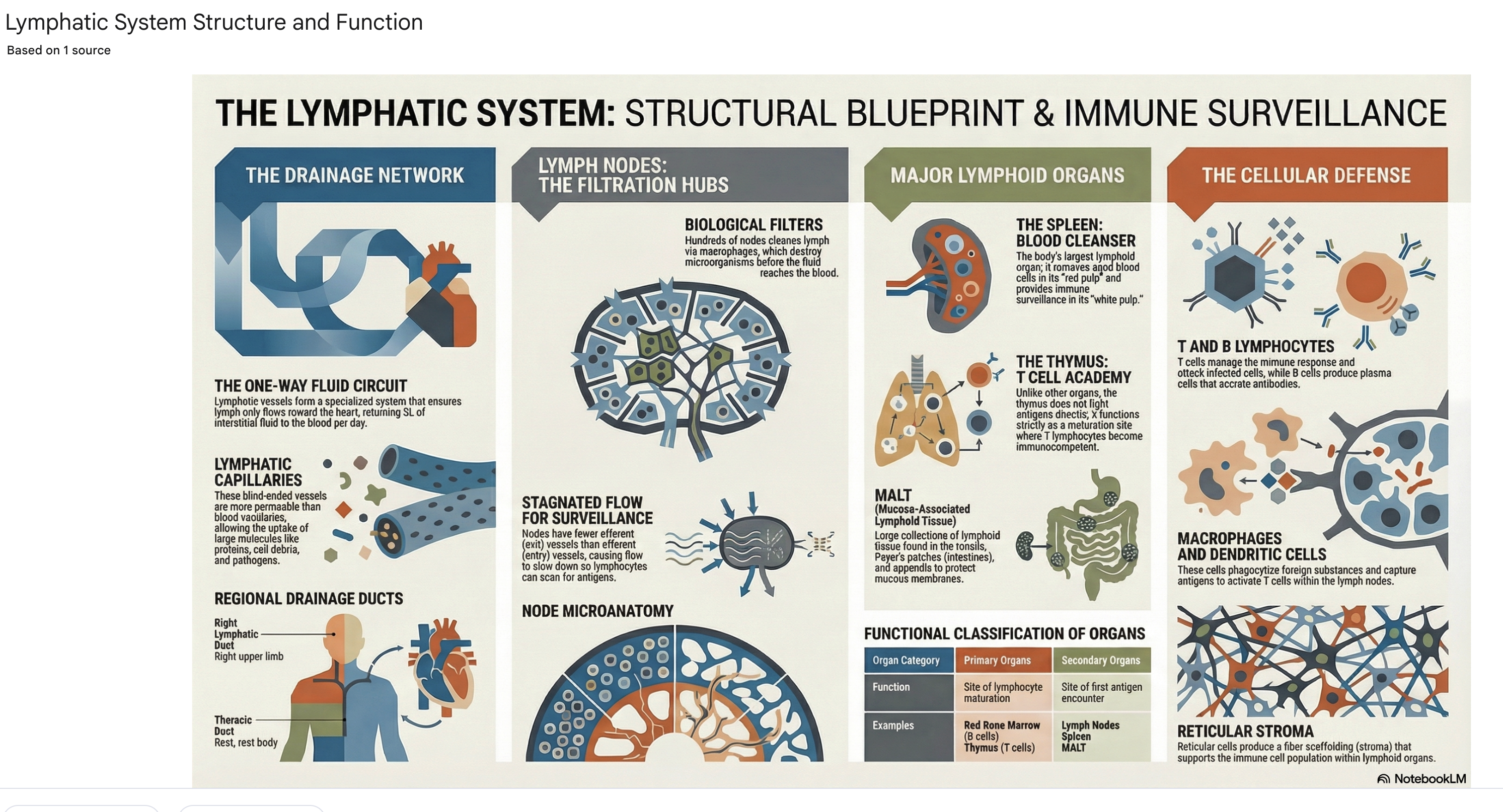
Overview Infographics

_______________________________________________________________
🎀 THE ADAPTIVE IMMUNE SYSTEM - QUICK SUMMARY
Definition: A specific, systemic defensive system that eliminates almost any pathogen or abnormal cell in the body. It amplifies the inflammatory response and activates complement, but it must be primed by an initial exposure to a specific foreign substance (which takes time).
Two Main Branches:
- Humoral (Antibody-Mediated) Immunity: B cells produce antibodies that circulate freely in body fluids, marking extracellular targets for destruction.
- Cellular (Cell-Mediated) Immunity: T cells act against cellular targets (infected cells, cancer cells) directly by killing them, or indirectly by releasing chemicals to enhance inflammation.
✅ KEY CONCEPTS: ANTIGENS & RECOGNITION
- ✅ Specific, Systemic, & Memory-Driven: The adaptive system targets highly specific antigens, operates body-wide, and mounts stronger attacks upon secondary exposures.
- ✅ Complete Antigens: Possess both immunogenicity (ability to stimulate lymphocyte proliferation) and reactivity (ability to react with activated lymphocytes/antibodies). Examples: foreign proteins, large polysaccharides.
- ✅ Haptens (Incomplete Antigens): Small molecules (peptides, poison ivy, pet dander) that are not immunogenic on their own. They cause immune responses only when they attach to the body's own proteins and appear foreign.
- ✅ Antigenic Determinants: The specific parts of an antigen that antibodies and lymphocyte receptors bind to.
- ✅ Self-Antigens (MHC Proteins): Glycoproteins on your own cells that identify you as "self." T-cells can only recognize antigens when presented on these MHC proteins.
- 1. Origin: Both B and T lymphocytes originate in the red bone marrow.
- 2. Maturation: Lymphocytes must develop Immunocompetence (recognize 1 specific antigen) and Self-tolerance (unresponsive to self-antigens). B cells mature in the Bone Marrow. T cells mature in the Thymus.
- T-Cell Tests: Positive Selection (must recognize self-MHC) and Negative Selection (must NOT recognize self-antigens; failure leads to apoptosis/clonal deletion).
- 3. Seeding: Naive cells colonize secondary lymphoid organs (lymph nodes, spleen).
- 4. Activation (Clonal Selection): Lymphocyte binds to its specific antigen.
- 5. Proliferation: Forms an army of identical clones (effector cells and memory cells).
- Antigen-Presenting Cells (APCs) Cells that engulf antigens and present fragments of them to T cells for recognition.
- Dendritic Cells: Mobile sentinels found in the epidermis and connective tissues. They catch pathogens and travel to lymph nodes (the most effective antigen presenters).
- Macrophages: Present antigens to activate T cells, which in turn turns the macrophage into a "voracious phagocytic killer."
- B Cells: Present antigens to helper T cells to assist in their own activation.
The Humoral Immune Response Triggered when a B cell encounters a target antigen.
- Antigen binds to surface receptors, triggering receptor-mediated endocytosis.
- Plasma Cells: Most clones become these antibody-secreting factories (2,000 molecules/second for 4-5 days).
- Memory Cells: Clones that do not become plasma cells remain to mount immediate responses to future exposures.
- Immunological Memory & Types of Immunity
- Primary Response: First exposure. Lag period of 3-6 days; antibody levels peak at 10 days, then decline.
- Secondary Response: Re-exposure. Sensitized memory cells respond in hours. Antibody levels peak in 2-3 days at much higher, more effective levels.
- Active Immunity: Your B cells make antibodies. Natural: Infection. Artificial: Vaccines (dead/attenuated pathogens).
- Passive Immunity: Ready-made antibodies are introduced. Natural: Mother to fetus (placenta/milk). Artificial: Injection of serum (gamma globulin). Memory is NOT formed.
Antibody Structure & Classes (MADGE) Antibodies (Immunoglobulins or Igs) are Y-shaped proteins with 2 Heavy (H) chains and 2 Light (L) chains. The ends of the arms are Variable (V) regions (antigen-binding sites), and the stem is the Constant (C) region (determines class/function).
- IgM: Pentamer (huge); first antibody released; potent agglutinator.
- IgA: Dimer; found in body secretions (mucus, saliva, milk).
- IgD: Monomer; functions as the B cell receptor.
- IgG: Monomer; 75-85% of plasma antibodies; main secondary response antibody; crosses the placenta.
- IgE: Monomer; triggers mast cells to release histamine (allergies); targets parasitic worms (destroyed alongside eosinophils).
Mechanisms of Antibody Action (P.L.A.N.) Antibodies do not destroy antigens directly; they inactivate and tag them!
- P - Precipitation: Soluble molecules are cross-linked into heavy complexes that settle out of solution for easier phagocytosis.
- L - Lysis (Complement Fixation): Several antibodies bind close together on a cell, aligning stems to trigger complement proteins, leading to a hole in the membrane and cell lysis.
- A - Agglutination: Antibodies bind to determinants on multiple antigens, cross-linking them into large, clumpy lattices (e.g., mismatched blood transfusions).
- N - Neutralization: Antibodies physically block specific sites on viruses or bacterial toxins, preventing them from binding to tissue cells.
Google Notebook LM review videos
You can create your own study notes, videos, flowcharts, flip cards and review quizzes using this free site. The following are a few videos created by loading the chapter powerpoint and then ask Notebook LM to create study resources.
An introduction to Google Notebook LM
______________________________________________________________
Crash Course overview videos
_______________________________________________________________
In a Nutshell series
_______________________________________________________________
Section C video Part 1
Section C video Part 2
Great overview of B cell activation
Antibodies and T cells(starts at 1hour:10minutes)